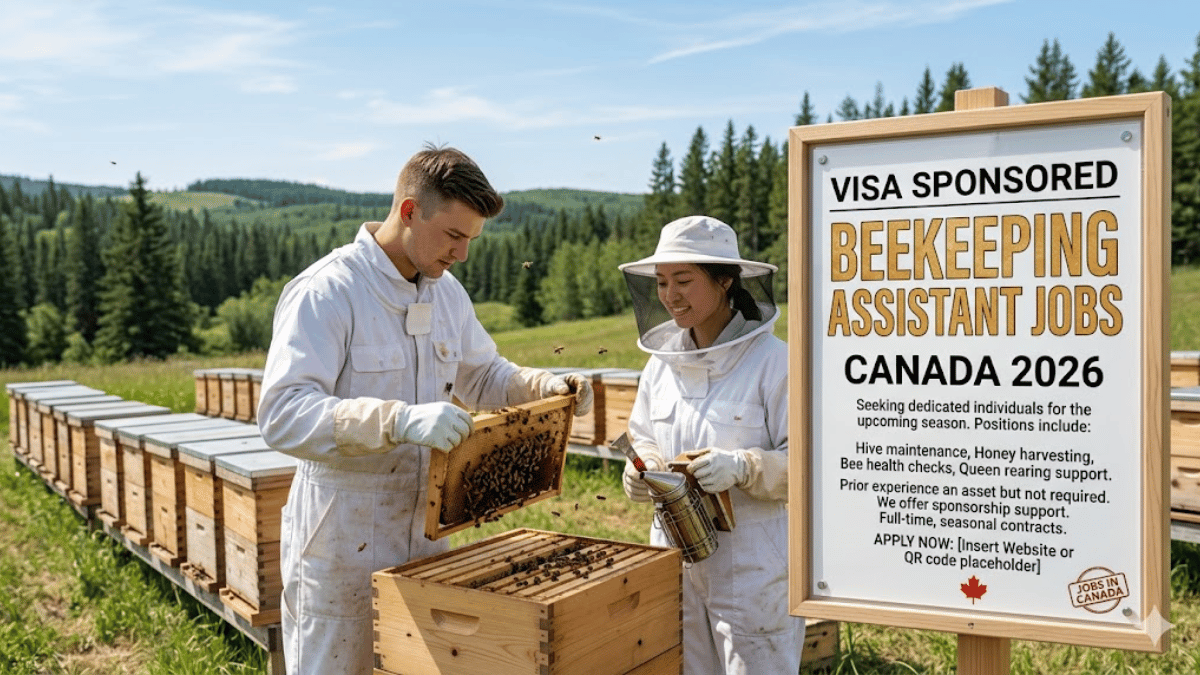
Canada is one of the world’s leading honey producers, and its beekeeping industry — concentrated in Alberta, Saskatchewan, and Manitoba — faces a serious labor shortage. Employers are actively sponsoring foreign workers through the Temporary Foreign Worker Program (TFWP) to fill beekeeping assistant roles across the country in 2026.
🐝 What Does a Beekeeping Assistant Job Involve?
- Inspecting bee colonies for signs of disease, queenlessness, and pest infestation
- Assisting in hive splitting and swarm management
- Applying treatments for Varroa mite control and other bee diseases
- Extracting and processing honey using mechanical extractors
- Moving hives to pollination sites for crops including canola and blueberries
- Maintaining and repairing hive equipment (boxes, frames, supers)
- Packaging and labeling honey and beeswax products
- Operating farm vehicles and equipment for hive transportation
🛂 Visa Sponsorship Process in Canada
Same LMIA-based process as all Canadian agricultural roles:
- Employer secures a positive LMIA from ESDC.
- Job offer issued to the foreign worker.
- Worker applies for a Temporary Work Permit through IRCC.
- Biometrics and medical exam completed.
- Worker travels and begins employment.
⏱️ Timeline: 6 to 12 weeks typically.
📋 Eligibility Requirements
- Experience with bees or other insects/animals preferred but not mandatory
- Comfort working outdoors in all weather conditions
- Ability to lift hive boxes (up to 30 kg)
- Tolerance for bee stings (beekeepers build immunity over time)
- Police clearance and medical exam
- Valid passport
💰 Salary & Benefits
- CAD 16.50 – CAD 19.00/hour (USD 12 – USD 13.80/hour)
- Peak season: May to September (harvest extension into October)
- Employer-arranged accommodation
- Workers’ Compensation coverage
- Potential Agri-Food Pilot PR pathway after 1 year of qualifying experience
🔍 Where to Find These Jobs
| Platform | Website |
|---|---|
| Job Bank Canada | www.jobbank.gc.ca |
| FARMS Canada | www.farmscanada.ca |
| Alberta Agriculture Jobs | www.alberta.ca |
| AgriRecruit | www.agrirecruit.ca |
| www.linkedin.com |
✅ Tips for Applicants
- Alberta is the largest honey-producing province — concentrate your search there.
- A basic beekeeping course (many available online) greatly improves your employability.
- Be upfront about any bee venom allergy history — this is a safety requirement.
Conclusion
Beekeeping assistant roles in Canada offer a genuinely rewarding outdoor work experience with a clear path toward permanent residency. For workers interested in agriculture and animal care, this is one of Canada’s most unique visa-sponsored opportunities in 2026.
FAQs
1. Is beekeeping experience required? Preferred but not mandatory — training is provided on the job.
2. What if I’m allergic to bee stings? Severe bee venom allergy typically disqualifies applicants for safety reasons.
3. Is this seasonal work? Primarily May–October, though some operations offer year-round roles.
4. What province has the most positions? Alberta, followed by Saskatchewan and Manitoba.
5. Can I apply for PR after this job? Yes — through the Agri-Food Pilot after 1 year of non-seasonal qualifying work.